

The CSiM Exchange
Advancing Stewardship, Quality, and Collaboration in Rural Health.
Our quarterly newsletter brings together timely updates in stewardship, infectious diseases, and rural health—highlighting practical tools and emerging topics designed to support clinicians and partners serving rural communities.
In this Winter 2026 issue you can find:
- A clinical update on shingles vaccination, including emerging data on potential neurologic benefit
- Updates to the CSiM Nursing Stewardship Curriculum
- An update to the CSiM Antibiotic Pocket Guide
- Highlights from our participation in the National Rural Health Policy Institute in Washington, DC
- Details on the upcoming Northwest Rural Health Conference
The CSiM Exchange is open to current partners, past participants, and those newly engaging with our work. If you are interested in learning more, email us at uwcsim@uw.edu
We look forward to continuing to share resources and insights to strengthen stewardship, quality improvement, and rural health systems.
Bugs and Drugs
Shingles Vaccination and Dementia: What the New Data Show
You may have heard the exciting news that getting the recombinant shingles vaccine (RZV, Shingrix) may be associated with a lower risk of dementia. Our understanding of this association is still in the early stages, but the data are very compelling:
- A large Wales cohort study published in early 2025 found ~20% lower dementia incidence among older adults receiving a shingles vaccine compared with unvaccinated peers.[1] Interestingly, the protective effect was stronger in women compared to men.
- A 2021 study that included Veterans Health Affairs medical records and Medicare claims showed a significantly lower risk of dementia in patients who had been vaccinated (Proquad, Varivax, Zostavax, or Shingrix) compared to those who had not (VHA HR = 0.69; 95%CI: 0.67–0.72; MarketScan HR = 0.65; 95%CI:0.57–0.74). Vaccination was also associated with a lower risk of Alzheimer’s dementia.[2]
- A recent comparative analysis reported that adults receiving RZV experienced a 17% increase in dementia-free time (≈164 additional days before diagnosis among those who ultimately developed dementia) compared with recipients of the older live zoster vaccine.[3]
- Studies comparing RZV to other adult vaccines (e.g., influenza, Tdap) also reported lower dementia risk among RZV recipients.[4]
Proposed mechanisms include reduced VZV reactivation in neural tissues and decreased neuroinflammation, but these remain theoretical. These data align with other studies pointing to a neurological injury associated with shingles, particularly shingles involving the eye (zoster ophthalmicus). While not yet part of formal dementia prevention guidelines, these data add to a body of evidence that reducing chronic infections and reactivations may positively influence long-term neurologic health.
The only shingles vaccine available in the U.S. is the recombinant zoster vaccine, RZV/Shingrix. For adults, this vaccine has transformed shingles prevention. RZV/Shingrix offers >90% protection against shingles and postherpetic neuralgia in adults ≥50 years and in immunocompromised adults ≥19 years.[5] Its effectiveness remains high for at least 7 years in available follow-up data. By reducing reactivation, population-level uptake also lowers complications such as ophthalmic zoster and chronic neuropathic pain.
Patients with a history of shingles should still receive RZV/Shingrix to prevent recurrence. Vaccination is also critical for immunocompromised patients—these groups have the highest risk for severe, disseminated VZV infections. RZV/ Shingrix remains underutilized in many areas and should be offered during routine visits (pharmacy or primacy care) for:
Making RZV/Shingrix easily accessible is a high-impact, low-effort intervention not only for shingles prevention but also (possibly) for reducing the risk of dementia for your patients.
- [1] Eyting, M. et al. A natural experiment on the effect of herpes zoster vaccination on dementia. Nature 641, 438–446 (2025).
- [2] Scherrer, J. F. et al. Impact of herpes zoster vaccination on incident dementia: A retrospective study in two patient cohorts. PLoS ONE 16, e0257405 (2021).
- [3] Taquet, M., Dercon, Q., Todd, J. A. & Harrison, P. J. The recombinant shingles vaccine is associated with lower risk of dementia. Nat. Med. 30, 2777–2781 (2024).
- [4] Maggi, S. et al. Association between vaccinations and risk of dementia: a systematic review and meta-analysis. Age Ageing 54, afaf331 (2025).
- [5] Cunningham, A. L. et al. Efficacy of the Herpes Zoster Subunit Vaccine in Adults 70 Years of Age or Older. N. Engl. J. Med. 375, 1019–1032 (2016).
- [6] CDC: Shingles Vaccination
- [7] CDC: Shingles Vaccination
The Stewards Toolkit
New Stewardship Nursing Curriculum: Join Us March 3rd
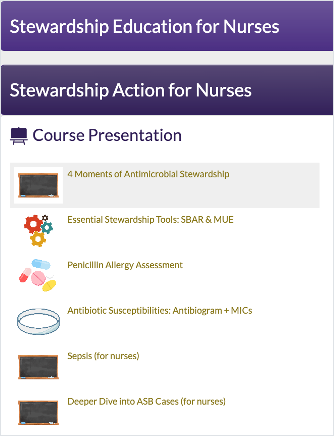
Inviting all nurses! Please invite all nurses from your hospital, regardless of background or role, to join March 3rd’s TASP session to learn about our new stewardship nursing curriculum. We are introducing two practical, evidence-based resources designed to strengthen antibiotic decision-making and support safer patient care:
CSiM Antibiotic Pocket Guide is now in print!
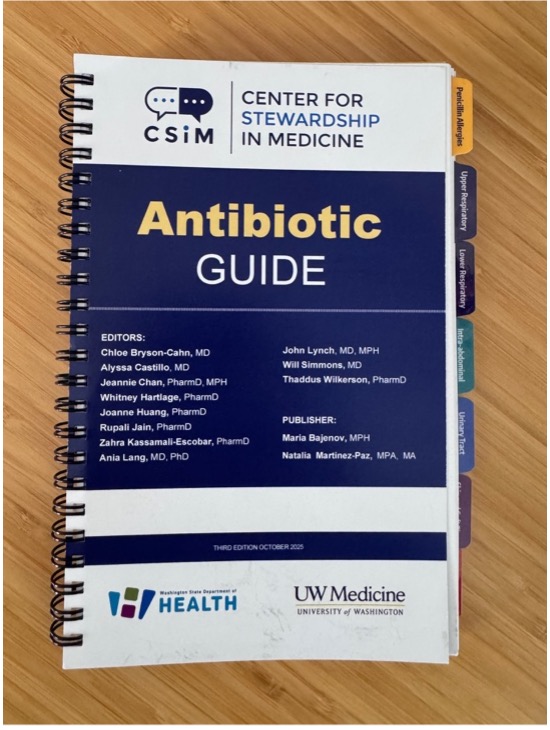
In our November newsletter we shared that the 3rd edition of the CSiM Antibiotic Pocket Guide is available to everyone on our website. We encourage you to download, review, and share it with colleagues and partners across your network!
For currently participating sites, printed copies are scheduled to arrive by mail in late March.
Events and Announcements
CSiM at the Northwest Rural Health Conference | March 10–12, Spokane, WA
The Northwest Rural Health Conference is coming up March 10- 12 in Spokane, WA. This conference brings together rural healthcare professionals and subject matter experts from the field to collaborate, educate, and brainstorm innovative ways to bring quality care to our rural communities. CSiM will attend, let us know if you’d like to connect!
National Rural Health Policy Institute
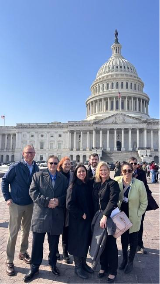
In mid-February, Natalia Martinez-Paz, CSiM Program Director, traveled to Washington, DC with a delegation of rural health leaders to participate in the National Rural Health Policy Institute. During the visit, the WA delegation met with congressional members and staff to advocate for Critical Access Hospitals, the reauthorization of the Medicare Rural Hospital Flexibility Program, and rural communities.
Many thanks to Jacquelin Maycumber from NRHA for coordinating a full day of meetings with Senators Patty Murray and Maria Cantwell, and Representatives Michael Baumgartner, Suzan DelBene, Marie Gluesenkamp Perez, Dan Newhouse, and Kim Schrier.
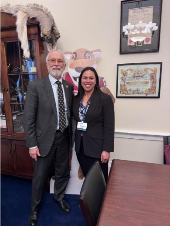
And for the WSU Cougars out there (especially our pharmacy grads), you would appreciate the decor in Representative Newhouse’s office. He was even kind enough to offer a photo with Butch, assuring us that the figure on the mantle was definitely not a Husky.